 English ▾
 Slovenian
 Serbian


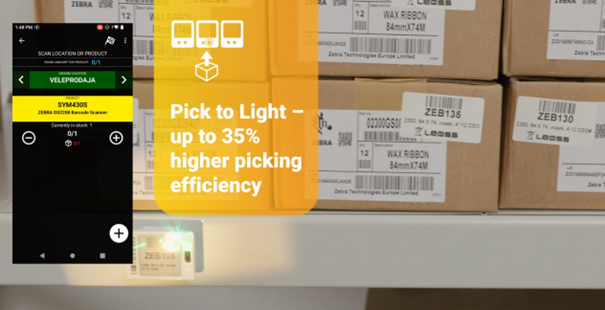
Pick to Light vs. Traditional Order Picking: The Future of Warehouse Optimization
Order picking is one of the most important processes in a warehouse and at the same time one of the biggest cost drivers. The speed and accuracy of picking determines whether the customer will receive their products on time and without errors. In the age of e-commerce, where orders are becoming more frequent and quantities smaller, companies increasingly ask themselves: which method of order picking is the best – traditional picking or the Pick to Light system?
What is Traditional Picking?
In traditional picking, a warehouse worker uses a paper list or a handheld RF terminal to locate items. This is a conventional method that almost every warehouse employee is familiar with.
Advantages of traditional picking:
- easy to implement,
- low initial costs,
- proven and familiar method.
Disadvantages of traditional picking:
- a lot of time spent searching for items,
- long walking routes through the warehouse,
- higher risk of picking errors.
What is Pick to Light?
Pick to Light is a modern light-directed picking system. Above the shelves, display units with lights are installed. When a warehouse worker receives an order, the light turns on at the exact product location, and the display shows the required quantity.
Advantages of the Pick to Light system:
- faster item location,
- fewer errors,
- easy to use even for new employees.
Disadvantages of the Pick to Light system:
- high initial investment,
- additional equipment and maintenance costs.
Practical Test
To verify the efficiency of different picking methods in practice, we conducted an experiment at the Laboratory for Cognitive Systems in Logistics (LKSL) at the Faculty of Logistics, University of Maribor.
As part of the Warehouse Operations course, we prepared three different tasks, each with a different picking method:
- Paper-based picking,
- RF terminal picking,
- combination of RF terminal and Pick to Light.
Measurement Results
When we compared the results of all three picking methods, the differences became very clear.
Paper-based picking turned out to be the least effective. Students needed the most time because they had to search for items on the list and simultaneously ensure they didn’t make mistakes. It became evident that paper is inefficient and outdated under heavier workloads.
RF terminal picking was significantly better. Students had precise instructions on the handheld terminal about what and where to pick. This shortened the time and reduced errors, since they only needed to scan the barcode of the item and confirm the quantity.
The greatest improvement came from the combination of RF terminal and Pick to Light. The lights guided the students directly to the correct items, eliminating the need for searching, while the terminal ensured accurate stock recording.
The results showed that this combination was more than 35% faster than using RF terminals alone. This means that order preparation time can be significantly reduced, while the probability of errors also decreases.
In a real warehouse with thousands of orders per day, such a difference translates into hours of saved labor and considerably lower operating costs.
Which System to Choose?
For smaller warehouses or companies with lower order volumes, traditional picking is still a sufficient option.
For larger companies and e-commerce businesses, where orders are frequent and time is critical, Pick to Light proves to be an investment that pays off – through faster processes, fewer errors, and higher customer satisfaction.
Many companies choose a combined approach: Pick to Light for smaller items and fast orders, while RF terminals are used for larger products and more demanding traceability.
Conclusion
Compared to traditional picking, Pick to Light has proven to be faster and more accurate. Although it requires a larger initial investment, this is offset by greater efficiency and fewer errors in order processing. For companies handling large volumes of orders, especially in e-commerce, implementing Pick to Light can provide a crucial competitive advantage.
🎥 If you want to see how the system works in practice, watch the short video about Pick to Light picking 👇


Comments are closed