 English ▾
 Slovenian
 Serbian


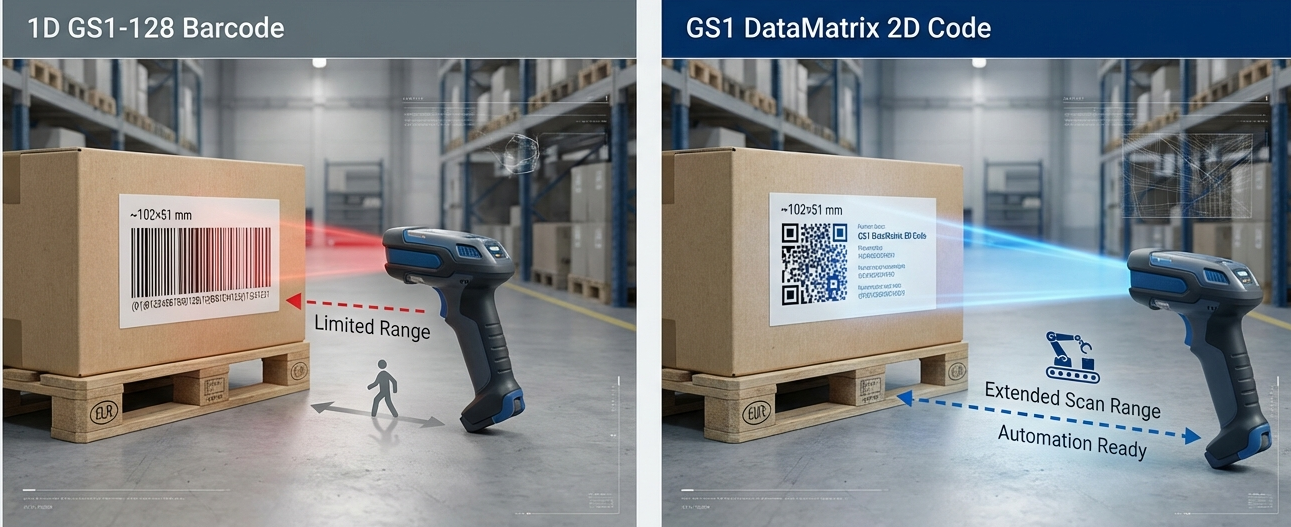
Evolution in logistics: why 2D codes on the basic logistics label are no longer the future, but a reality
The digitalisation of logistics processes requires reliable, fast, and robust data capture. GS1 Slovenia analysed the efficiency of 1D and 2D codes on the basic logistics label in a professional-practical study and examined the operational impacts of using 2D symbology in real-world conditions.
LEOSS participated in the testing as a technology partner, providing modern equipment for conducting measurements in a controlled environment.
You can read the full original article here:
What was the subject of the research?
The study compared:
- the linear GS1-128 code with the SSCC identifier
- the two-dimensional GS1 DataMatrix code
It is important to emphasise that in both cases only the SSCC was encoded. The research therefore did not compare the amount of data, but rather the efficiency of the symbology with identical content.
The objective was to verify:
- the successful scanning distance,
- the impact of symbol size and X-dimension,
- the potential of 2D codes as an evolutionary step in logistics.
Test environment and equipmen
The testing was conducted by GS1 professional staff under controlled conditions, with the labels applied in accordance with standards.
Next-generation handheld terminals from the following manufacturers were used:
- Zebra Technologies
- Datalogic
These were imaging scanners (camera-based image capture), which today represent the industry standard and enable reliable reading of both 1D and 2D codes.
Key research findings
Comparison of scanning range:
| Range type | Range 1D (cm) | Range 2D (cm) | Increase (%) |
| Short | 80-100 | 120-150 | +50 |
| Medium | 270 | 670 | +148 |
| Long | 450 | 670 | +49 |
The greatest difference was observed at medium distances, where the 2D code enabled nearly 2.5 times greater range.
In practice, this means:
- less stopping of forklifts,
- fewer repeated scanning attempts,
- less need for precise positioning,
- higher process throughput.
Why is the 2D code more efficient?
The key factor in the tested scenario was not the amount of data, but the larger X-dimension of the 2D symbol.
A larger module means:
- better detectability at greater distances,
- more stable decoding,
- greater robustness in real environments.
An additional advantage of GS1 DataMatrix is its built-in error correction (ECC 200), which enables decoding even when the symbol is partially damaged.
Implications for logistics processes
Greater scanning range has a direct impact on operational efficiency. In environments with high goods throughput, “micro-delays” — repeated scanning attempts, approaching the pallet, searching for the optimal angle — quickly add up to measurable time losses.
The research shows that using a 2D code even solely for SSCC represents a pragmatic first step toward:
- increased automation,
- the use of fixed scanners at docks,
- contactless identification processes,
- advanced track & trace solutions.
Evolution, not revolution
The study clearly indicates that introducing a 2D code is not necessarily associated with extensive changes to information systems or data structures.
Simply replacing the data carrier (1D → 2D), while maintaining the same content (SSCC), delivers measurable operational benefits.
For organisations, this means:
- a low entry threshold,
- limited risks,
- a rapid impact on efficiency.
Looking ahead
The research results confirm that 2D codes are no longer an experimental technology, but a practical foundation for future digital logistics.
Greater range and robustness enable the development of solutions such as:
- automatic identification at transshipment docks,
- drone-based inventory counting,
- direct matching of physical flow with EDI messages (e.g. DESADV),
- tighter integration with WMS and ERP systems.
In logistics, 2D codes are therefore no longer a question of “if”, but “when and how.”

Comments are closed