 English ▾
 Slovenian
 Serbian


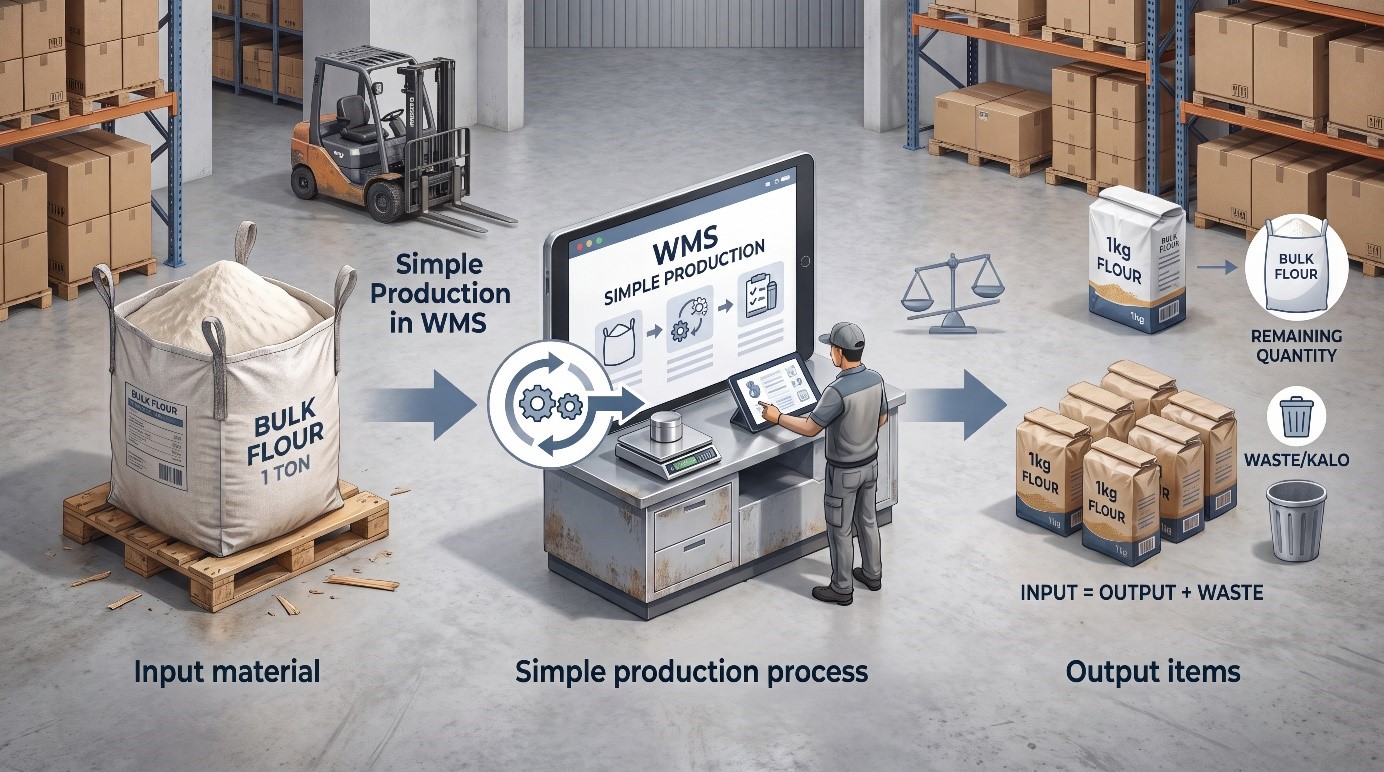
Simple production in WMS: when one item becomes several smaller units
Simple production in the WMS system enables users to clearly record cases where one item is divided into smaller pieces or units. The functionality is intended primarily for processes that are not complex production, but simple repackaging, cutting, splitting, or similar processing of an existing item.
A typical example is 1 ton of flour that is packed into 1-kilogram bags. During this process, some waste or shrinkage may also occur, and part of the original item may remain and be received back as a remainder.
Three documents in one procedure
Simple production in WMS combines three key documents:
Receipt
With this document, we record the items created as the result of the procedure. These may include, for example, smaller packages or the remaining material.
Issue
With the issue document, we record the item or quantity used as the basis for the production procedure.
Shrinkage
Shrinkage represents the difference or waste that occurs during the procedure. This is the quantity that can no longer be received as a usable item.
In this way, the user completes the entire procedure in one place, without separately creating multiple documents manually.
When do we use simple production?
This functionality is used when we have an initial item that we split, repackage, or otherwise convert into different quantity forms. It is important that the quantities match correctly.
Example:
- we issue 1,000 kg of flour from the warehouse,
- we receive 950 bags of 1 kg each,
- we also receive 40 kg of remainder,
- 10 kg is recorded as shrinkage.
In this example, the initial quantity of 1,000 kg is equal to the final quantity:
950 kg received + 40 kg remainder + 10 kg shrinkage = 1,000 kg
The difference must always be 0
The key rule of simple production is that the difference in the lower part of the screen must always be 0.
This means that the total quantity of the issued item must equal the total quantity of received items, remainders, and shrinkage. The system thereby ensures that inventory is correctly aligned and that no unexplained differences occur in the process.
If the difference is not 0, the procedure has not been completed correctly. In that case, it is necessary to check:
- whether the correct initial quantity was issued,
- whether all new units have been received,
- whether any remainder has been recorded,
- whether shrinkage has been entered correctly.
Benefits of the functionality
With simple production, users gain a fast and clear way of working with simple production procedures. Instead of preparing the receipt, issue, and shrinkage documents separately, they can complete everything in one connected process.
The main benefits are:
- less manual work,
- fewer chances of errors,
- better overview of material consumption,
- correct recording of shrinkage,
- better aligned inventory,
- easier monitoring of repackaging or item-splitting procedures.
Conclusion
Simple production in WMS is intended for all cases where several smaller units or a different quantity form of the same or a related item are created from one item. The functionality combines receipt, issue, and shrinkage, and ensures that the initial quantity is always aligned with the final quantity.
The most important rule when using it is simple: the difference must always be 0. This ensures the correct inventory status and full traceability of the entire procedure.

Comments are closed